

How aligning operations and revenue cycle management can reduce subsidy pressure, protect procedural access, and improve financial performance

Executive Summary
Anesthesiology financial performance is often managed as two separate problems: the cost and operational side of coverage, and the revenue side of billing and collections. That separation can obscure the real issue. The two are often structurally connected. Staffing models, utilization, scheduling, provider turnover, medical direction, documentation practices, and the location of care all influence what can be billed, how quickly it can be billed, and how much of that work is ultimately collected.1
At the same time, strong revenue cycle management cannot compensate for chronically underused staff capacity, fragmented procedural schedules, or excessive reliance on premium labor. Operational efficiency cannot compensate for incomplete documentation, delayed provider enrollment, weak payer performance, coding errors, preventable denials, or any other deficiency in the revenue cycle. Financial improvement requires the two disciplines to work as one collaborative system.
Operations Create the Conditions for Revenue
The care team model, staffing pattern, case schedule, medical direction status, NORA demand, and documentation behavior all shape billability and collections.
RCM Converts Delivered Care Into Reimbursement
Anesthesia-specific coding, provider enrollment, payer strategy, claim management, denials, and collections determine how much of the clinical work becomes realized revenue.
Waste Can Exist on Both Sides of the Equation
Hospitals can overpay for unproductive coverage while also leaving reimbursement uncollected. Looking at only cost or only collections can misdiagnose the problem.
The Management Model Should Be Shared
The C-suite, anesthesiology leadership, perioperative leadership, finance, and the RCM team need common definitions, common data, and a short list of paired operating and financial metrics.
Executive Question
Where is value being lost between staffed capacity, delivered care, documented care, billed care, and collected revenue? The answer is rarely owned by one department.
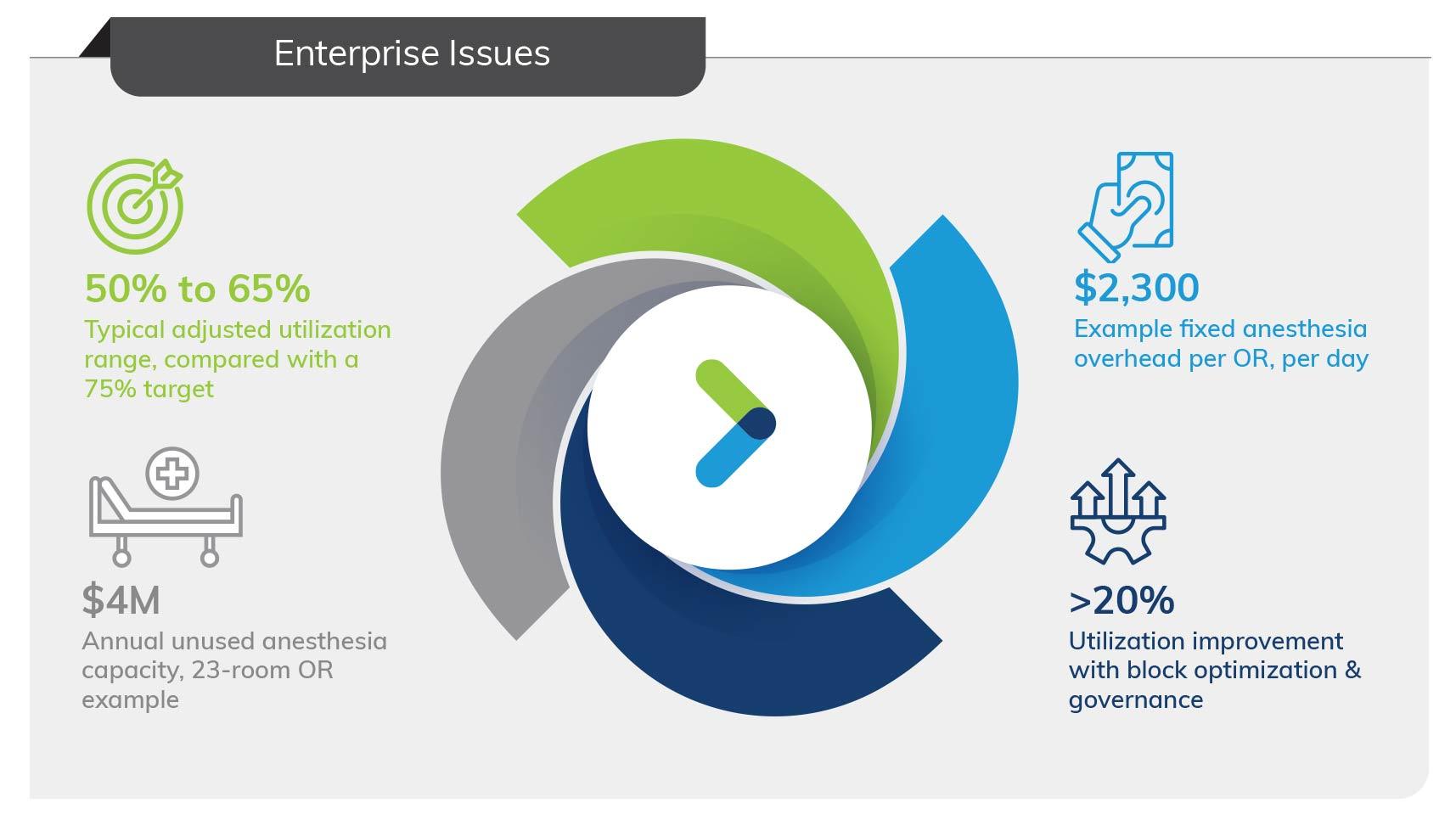
Surgical Directions recommends evaluating adjusted OR utilization against a practical target of approximately 75 percent, while many hospitals operate closer to 50 to 65 percent. In one 23-room OR example, fixed anesthesia overhead of approximately $2,300 per staffed OR per day contributed to an estimated $4 million in annual unused anesthesia capacity when staffed rooms were not consistently utilized. Surgical Directions has also documented utilization improvements greater than 20 percent through stronger block management and governance. These figures illustrate how aligning coverage, scheduling, care team design, and workforce deployment with actual procedural demand can improve the productive use of anesthesia capacity before additional staffing or financial support is added.
The revenue side is equally measurable. In a 2026 Ventra Health case study, Centra Health’s anesthesia service line reported average days in A/R of 35, an average denial rate below 5 percent, and 20 percent of A/R over 90 days, excluding self-pay. Following the 2024 Change Healthcare disruption, the service line also reported a 4.3 percent improvement in Net Collections Rate, a $46,000 increase in average monthly collections, and an $18 increase in collections per visit. These results are specific to Centra Health and should be viewed as a case example, not a universal benchmark.9
The Challenge
Anesthesiology Economics Have Become an Enterprise Issue
Anesthesiology has moved well beyond a vendor or coverage discussion. Surgical Directions notes that escalating subsidies, workforce shortages, rising compensation expectations, locum dependence, reimbursement pressure, and growing procedural demand now directly influence access, margin, physician alignment, and hospital performance.1
The scale of the opportunity is substantial. Surgical services can represent up to 70 percent of hospital revenue, and the operating room itself is estimated to cost approximately $80 per minute. When anesthesiology capacity is not aligned with demand, hospitals can pay for idle coverage while simultaneously limiting the very surgical growth needed to absorb those costs.2
These figures reinforce an important point: the anesthesia subsidy is often heavily infuenced by the operating model, not a stand-alone problem. In one Surgical Directions example, a 23-room OR carried approximately $4 million in annual unbillable anesthesia capacity because staffed rooms were not consistently used. No billing optimization can recover revenue for cases that never occurred or for staffed time that produced no billable service.3
Enterprise Issues
- 50% to 65% — Typical adjusted utilization range, compared with a 75% target
- $4M — Annual unused anesthesia capacity, 23-room OR example
- $2,300 — Example fixed anesthesia overhead per OR, per day
- >20% — Utilization improvement with block optimization & governance
The Core Insight
Operations and Revenue Cycle Are One Financial System
The most useful way to manage anesthesiology is to view operations and revenue cycle management as a continuous chain. Operational decisions create the clinical and documentation environment. Revenue cycle processes then convert that activity into reimbursement. The output of both becomes the hospital’s net anesthesiology economics, including the size and trajectory of any financial support.
| Area | Key Considerations |
|---|---|
| Operations | Operational expectations should address coverage and scheduling, utilization, care team model, NORA and procedural services, workforce deployment, and provider performance expectations, including availability, relief schedules, timely chart completion, and accurate documentation. |
| Revenue Cycle | Documentation, coding, enrollment, payer strategy, denials, collections |
| Enterprise Result | Access, subsidy, margin, workforce stability, growth |
Where the Intersection Shows Up in Daily Operations
| Operational Decision | Revenue Cycle Consequence | Enterprise Risk or Opportunity |
|---|---|---|
| Care team model & medical direction | Documentation & modifier requirements must match how care was actually delivered. | Incorrect or incomplete documentation can reduce reimbursement, increase denials, or create compliance exposure. |
| Staffing, drawdown, & after-hours coverage | Coverage patterns affect who is available, under what billing model, and whether the service remains within the intended care team model. | Higher labor cost, lower collections, or both. |
| Locums & new provider onboarding | New clinicians require timely payer enrollment & clear documentation expectations. | Enrollment lag can delay or prevent reimbursement while the hospital is already paying premium labor rates. |
| OR & NORA scheduling | Fragmented schedules create idle paid time & increase variability across documentation environments. | Higher cost per case, more overtime, & inconsistent charge capture. |
| Provider compensation & accountability | Compensation design can influence the urgency & consistency of chart completion and documentation. | Incomplete charts slow billing & can leave billable work uncollected. |
| Block utilization & surgeon access | Utilization determines whether expensive anesthesia capacity produces procedural volume. | RCM cannot monetize an empty staffed room; better utilization can lower the effective cost of coverage. |
| Two statements executives should keep in mind | Revenue cycle cannot monetize a staffed but empty anesthetizing location. Operations cannot collect a claim that was not properly documented, coded, enrolled, & submitted. |
|
Four High-Impact Pathways
How Better Operations Improve Revenue Cycle Performance
1 | Match the Care Model to the Real Work
The care team model is not only a staffing decision. How anesthesia providers are assigned, supervised, and deployed can also have direct billing and revenue implications. Key considerations include:
- Medical direction
- Medical supervision
- Independent practice for both CRNAs and anesthesiologists
- Provider-to-room ratios
- Break coverage
- Late-day staffing drawdown
Each model carries different operational, documentation, and billing requirements, making it important to align clinical practice, staffing structure, and revenue cycle processes. The operational design therefore has to be realistic for the volume, acuity, staffing market, and hours of service.
2 | Design Schedules That Produce Productive Anesthesia Time
Surgical Directions recommends managing adjusted OR utilization across operating rooms and procedural locations, with a 75 percent target as a practical benchmark in the typical hospital OR. Adjusted OR utilization reflects how effectively staffed room capacity is matched to actual procedural demand, accounting for scheduled case time, turnover, and other productive use of the room. The goal is not to force every room to remain full. It is to reduce avoidable white space, improve surgeon access, and align available capacity with demand.
Efficient OR utilization, however, does not automatically translate into efficient anesthesia utilization. Anesthesia utilization refers to how effectively scheduled anesthesia provider time is aligned with the actual clinical demand requiring anesthesia coverage. Improving productive anesthesia time therefore requires two connected steps.
First, hospitals must create an efficient OR and procedural schedule. Second, anesthesia staffing and coverage schedules must be built around that demand, so provider time is not lost to unnecessary gaps, overstaffing, poorly sequenced cases, or coverage that extends beyond productive procedural time.
When these two elements are managed together, hospitals can improve access and throughput while making better use of both OR capacity and anesthesia resources.3
3 | Treat Provider Enrollment and Documentation as Operational Workflows
Provider enrollment is often managed as an administrative task, but in anesthesiology it is tightly linked to workforce operations. When hospitals change groups, expand locations, rely on locums, or hire rapidly, the RCM team needs early visibility into who is coming, where they will practice, and when they will start. Ventra Health notes that enrollment status directly affects billing eligibility, reimbursement timing, and revenue risk.7
The same is true for documentation. Anesthesia billing requires specialty knowledge of time, base units, modifiers, medical direction, procedure documentation, and payer requirements. Providers entering a new environment may bring documentation habits shaped by a different care model, compensation structure, or set of expectations.
Compensation models can also influence how closely providers connect documentation quality with financial performance. For example, providers in a salary-based model may have less direct financial incentive to focus on complete and accurate documentation than those whose compensation is more closely tied to productivity or collections.
Regardless of the model, structured onboarding, clear chart completion expectations, routine monitoring, and targeted education are essential to support compliance, reduce revenue leakage, and improve accurate reimbursement.6
Specialty-specific coding capability can be measured as well. Ventra Health reports 98 percent coding accuracy for clients nationally across its professional coding services, which include anesthesia.6 Accurate coding does not replace good operations, but it improves the likelihood that properly documented clinical work is converted into a clean claim and appropriate reimbursement.
4 | Use RCM Data to Find Operational Problems Earlier
RCM should not be a retrospective financial report. Trends in cash per case or unit, aging, denials, payer yield, and missing documentation can reveal operational problems before they become a budget surprise.
For example, a sudden increase in locums may first appear as a labor expense, but it can also show up as enrollment delays, documentation variation, and slower cash conversion. Looking at the two data sets together provides a more complete root-cause analysis.
Ventra Health Evidence
What the Revenue Cycle Side Looks Like in Practice
Anesthesia revenue cycle management requires specialty scale and expertise. Ventra Health reports serving 971 anesthesiology facilities, processing approximately 18,000 claims per day, and achieving 98 percent coding accuracy for clients nationally.6 These figures describe Ventra Health’s operating scale and coding performance, not a guaranteed result for any individual hospital or anesthesia group.
Centra Health provides a more specific example of how disciplined RCM, provider communication, analytics, and operational coordination can work together. Centra’s anesthesia service line includes 35 anesthesiologists and 37 CRNAs (72 providers) and serves more than 28,000 patients annually. Ventra reports average days in A/R of 35, an average denial rate below 5 percent, and 20 percent of A/R over 90 days, excluding self-pay.9
The case is especially relevant because it demonstrates performance through disruption. After the February 2024 Change Healthcare cyberattack interrupted claims processing, Centra’s anesthesia collections recovered within four months. By year end, Net Collections Rate had improved 4.3 percent, average monthly collections had increased by $46,000, and collections per visit had increased by $18 compared with the prior year.9
The lesson for executives is not that one set of RCM tactics produces the same result everywhere. It is that revenue resilience improves when the RCM team has early visibility into provider status, documentation, payer changes, and operational shifts, and when both sides use the same data to identify and solve problems.
Avoid the Siloed Fix
Why Solving Only One Side Can Make the Problem Worse
Operations Alone
A hospital can improve utilization and staffing but still lose revenue if providers are not enrolled, documentation is incomplete, coding is inaccurate, payer performance is weak, or denials are not resolved.
RCM Alone
A hospital can improve claim performance, but RCM cannot offset chronic overstaffing, fragmented NORA demand, unused blocks, excessive premium labor, or a care model that does not match actual demand.
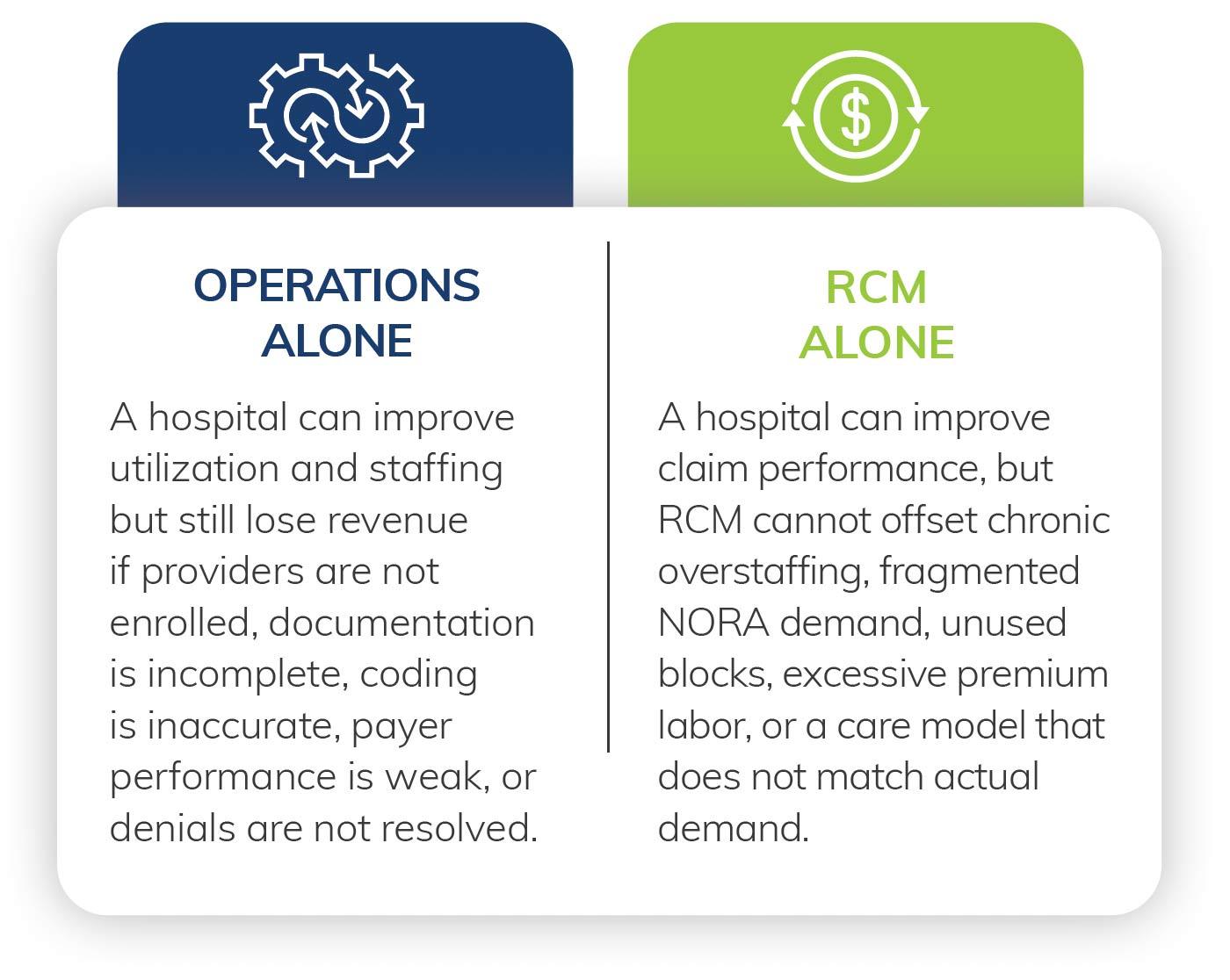 This is why switching vendors, changing anesthesia coverage models, or replacing a billing company does not automatically solve anesthesiology economics. The model may change, but the underlying drivers remain unless leadership addresses operations, workforce, contract expectations, documentation, payer performance, and collections together.
Surgical Directions makes a similar point in its 2026 C-suite anesthesiology guide: the right answer begins with strategy rather than a predetermined staffing or vendor model.1
Governance Is the Connection Point
A practical governance structure should bring together administration, anesthesiology, perioperative nursing, finance, surgeons and proceduralists, and the RCM partner. Surgical Directions recommends multidisciplinary surgical services governance with consistent definitions, shared dashboards, clear authority, and accountability for block allocation, staffing, access, and performance metrics.2
For anesthesiology, that governance agenda should include both sides of the economics: coverage, productivity, access, and workforce on one side, and documentation, enrollment, payer performance, aging, and collections on the other.
The goal is not more meetings. It is faster identification of where the model is leaking value and who owns the corrective action.
Executive Dashboard
Ten Metrics That Tell One Story
The strongest dashboard is not the one with the most measures. It is the one that connects operational capacity to realized revenue and makes trends visible enough to act on. Both Surgical Directions and Ventra Health emphasize a manageable set of measures rather than dashboard overload.
| Metric | What It Tells Leadership | Why It Matters |
|---|---|---|
| Adjusted utilization | How much allocated OR or procedural capacity is actually used, including turnover time. | Connects staffed capacity to productive procedural volume. |
| Cost per anesthetizing location | Total anesthesia labor and related cost relative to staffed locations. | Shows whether coverage expansion is financially sustainable. |
| Provider productivity | Clinical output by anesthesiologist, CRNA, or CAA against expected availability. | Highlights staffing mismatch, workload imbalance, & retention risk. |
| Locum expense | Premium temporary labor spend & trend. | Signals workforce instability & often predicts enrollment complexity. |
| Cost per case | Anesthesiology payroll, benefits, premium labor, & related cost divided by cases. | Shows whether operational changes are improving unit economics. |
| Net cash collection | Actual cash collected, tracked against expectation or forecast. | Provides the clearest view of cash realization. |
| Cash per case or unit | Average cash collected for the unit of clinical work selected by the organization. | Makes reimbursement trends comparable over time. |
| Days in the A/R | Average time required to convert billed work into cash. | Shows billing speed, payer delay, & process friction. |
| A/R over 120 days | Share of receivables that remain outstanding more than 120 days. | Highlights aged revenue at risk. |
| Insurance net collection rate | Collectible insurance revenue actually received after contractual adjustments. | Shows how effectively expected reimbursement becomes realized revenue. |
RCM metric definitions reflect Ventra Health’s core reporting framework, including Net Cash Collection, Cash Per Unit, Days in A/R, A/R greater than 120 days, and Insurance Net Collection Rate.5
Action Framework
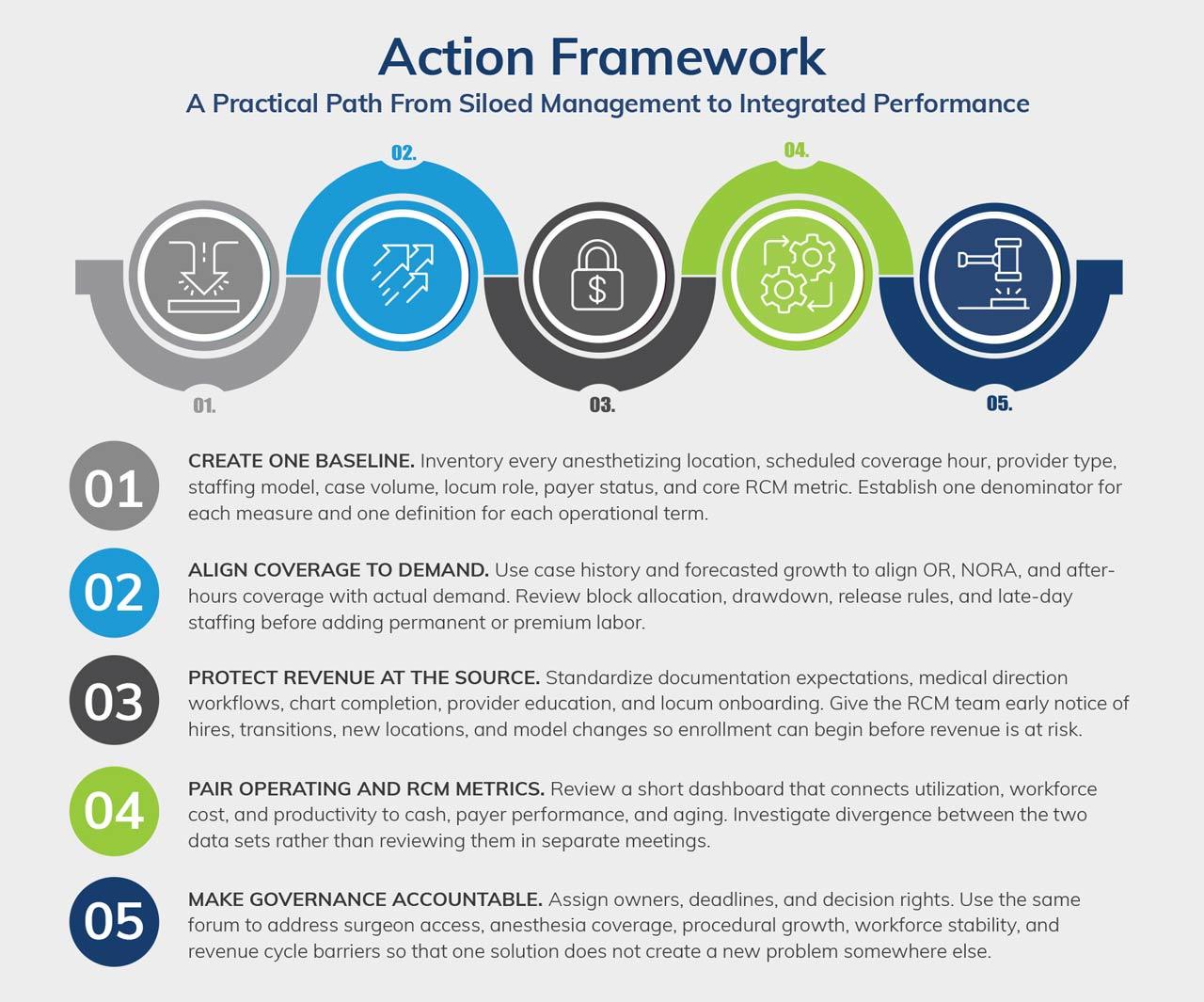
A Practical Path From Siloed Management to Integrated Performance
What Good Governance Sounds Like
If adjusted utilization is improving but cash per case is falling, ask why. If locum expense is rising and A/R days are worsening, examine enrollment and documentation. If collections are strong, but cost per anesthetizing location is rising, review coverage design, and schedule alignment.
- Create One Baseline.
Inventory every anesthetizing location, scheduled coverage hour, provider type, staffing model, case volume, locum role, payer status, and core RCM metric. Establish one denominator for each measure and one definition for each operational term. - Align Coverage to Demand.
Use case history and forecasted growth to align OR, NORA, and after-hours coverage with actual demand. Review block allocation, drawdown, release rules, and late-day staffing before adding permanent or premium labor. - Protect Revenue at the Source.
Standardize documentation expectations, medical direction workflows, chart completion, provider education, and locum onboarding. Give the RCM team early notice of hires, transitions, new locations, and model changes so enrollment can begin before revenue is at risk. - Pair Operating and RCM Metrics.
Review a short dashboard that connects utilization, workforce cost, and productivity to cash, payer performance, and aging. Investigate divergence between the two data sets rather than reviewing them in separate meetings. - Make Governance Accountable.
Assign owners, deadlines, and decision rights. Use the same forum to address surgeon access, anesthesia coverage, procedural growth, workforce stability, and revenue cycle barriers so that one solution does not create a new problem somewhere else.
What Better Alignment Can Change
- Lower effective cost of coverage by increasing productive use of staffed anesthesia capacity.
- Faster, more complete revenue capture through better documentation, enrollment, coding, and payer management.
- More predictable subsidies because cost and collections are managed together rather than explained after the fact.
- Better procedural access because staffing, scheduling, and growth plans are coordinated across OR and NORA locations.
- Stronger clinician alignment because anesthesiology leaders have a defined role in enterprise operating and financial decisions.
Case Example, Not Benchmark
Centra Health’s reported anesthesia RCM performance included 35 average days in A/R, less than 5 percent average denials, and 20 percent of A/R over 90 days, excluding self-pay.9 These figures are useful reference points for executive discussion but should not be treated as universal targets because payer mix, market conditions, staffing models, and operating environments vary by organization.
Conclusion
The New Anesthesiology Question Is Not Cost or Revenue. It Is Alignment.
Anesthesiology is one of the clearest examples of why hospital operations and finance cannot be managed in isolation. Every coverage decision has a financial consequence, and every revenue cycle result has an operational story behind it.
For the C-suite, the priority is to move beyond a narrow focus on subsidy, vendor selection, or staffing alone. For chief anesthesiologists, the opportunity is to connect clinical leadership more directly to access, productivity, documentation, and financial performance. For both groups, the highest-value work occurs where those responsibilities overlap.
Hospitals that align anesthesiology operations with specialized revenue cycle management gain a more complete view of performance. They can distinguish market-driven cost from operational waste, identify revenue leakage earlier, protect procedural access, and make better decisions about staffing, growth, contracts, and workforce strategy. In a market where there is no single silver bullet, alignment is the management discipline that makes every other lever more effective.
References
- Surgical Directions. “Anesthesiology Is No Longer a Vendor Management Problem: A C-Suite Guide to Stabilizing Costs, Improving Control, and Protecting Surgical Access.” July 2, 2026.
- Surgical Directions. “COO Guide to Perioperative Operational Improvements That Boost Financial Performance.” May 17, 2026.
- Blasco, Thomas, MD. “Increase OR Productivity, Cut Anesthesiology Stipend and Boost Hospital Profits.” Surgical Directions. February 1, 2024.
- Basham, Leslie. “Four Tactics to Transform Culture in Surgical Services.” Surgical Directions. February 25, 2024.
- Ventra Health. “RCM Metrics That Matter.” Accessed September 2026.
- Ventra Health. “Anesthesia Billing Services for RCM.” Accessed September 2026. https://ventrahealth.com/anesthesia/
- Ventra Health. “Provider Enrollment.” Accessed September 2026.
- Surgical Directions and Ventra Health. Joint podcast transcript featuring Jason Klopotowski, MD, and Jason Greenberg, MD. Recorded September 14, 2026.
- Ventra Health. “With Strong RCM Partnership, the Anesthesia Service Line is a Top Performer for Centra Health System.” 2024 https://ventrahealth.com/success-stories/centra-medical-group/