


Executive Summary
Hospitals are navigating unprecedented operational and financial pressure driven by labor shortages, inflationary supply costs, reimbursement compression, and rising patient acuity. For Chief Operating Officers (COOs), perioperative and surgical services represent both the greatest operational complexity and the greatest opportunity to improve financial performance. Surgical services often represent up to 70 percent of hospital revenue while consuming a significant portion of labor and capital resources.
When operations are misaligned, hospitals experience lost capacity, staff burnout, physician dissatisfaction, and margin erosion. Conversely, with operational optimization, hospitals unlock sustainable financial improvement while strengthening quality, access, and workforce stability.
This guide provides COOs with a comprehensive, evidence-based framework to drive operational improvements that directly enhance financial performance. Drawing from Surgical Directions’ extensive insights library and peer-reviewed clinical and operational literature, it outlines practical levers that improve throughput, reduce waste, enhance workforce performance, and align clinical and administrative leadership.
1. Establish Multidisciplinary Surgical Services Governance: Why Governance Drives Financial Performance
One of the most common root causes of underperforming surgical operations is fragmented decision-making. When surgeons, anesthesiologists, nursing leadership, finance, and operations work in silos, block time goes unused, staffing decisions become reactive, and accountability is diluted. Effective multidisciplinary governance creates a shared operating model where decisions are made transparently, supported by data, and aligned to enterprise goals. Strong governance has been shown to improve utilization, reduce delays, and accelerate operational improvement initiatives.
Financial Impact: Governance alignment reduces inefficiencies created by variability, enables faster corrective action, and improves trust between clinical and operational leaders.
Key Governance Actions for COOs
- Establish a Surgical Services Executive Committee (SSEC) with shared physician and administrative leadership.
- Ensure consistent representation from surgery, anesthesiology, perioperative nursing and operations, sterile processing, finance, and supply chain.
- Define a clear charter with authority and responsibility over block allocation, staffing standards, access rules, and performance metrics.
- Review performance dashboards regularly to guide data-driven decisions.
- Clarify that the Surgical Services Executive Committee functions as a decision-making body, not an advisory group, with defined accountability.
2. Optimize OR Scheduling and Utilization
Utilization as a Financial Lever
Operating room time is among the most expensive hospital resources, costing approximately 80 dollars per minute. Underutilized ORs represent lost revenue opportunity, while overextended schedules drive overtime and burnout.
Studies and operational benchmarks consistently demonstrate that decreasing OR white space during prime time hours by improving block utilization and overall OR utilization can significantly increase case volume without additional capital investment.
Inaccurate scheduling drives inefficiency across the entire perioperative continuum. When case duration estimates are inconsistent or overly optimistic, downstream impacts include delayed first case starts, increased turnover variability, overtime expense, staff dissatisfaction, and surgeon frustration. Even small variances in predicted versus actual case length compound over the course of a day, creating schedule compression and avoidable prime time loss.
Evidence: Hospitals implementing structured block optimization and utilization governance have demonstrated utilization improvements exceeding 20% and corresponding increases in surgical volume.
Financial Impact: Increasing OR capacity by optimizing utilization and scheduling improves OR revenue.
Best Practices
- Implement a standardized electronic scheduling process that includes required clinical detail and prior authorization.
- Utilize surgeon-specific case duration historical data.
- Establish clear add-on case workflows with defined cutoff times and approval pathways.
- Analyze historical block utilization by service, surgeon, and day of week.
- Reallocate underperforming blocks to services and specific surgeons with unmet demand.
- Establish clear block release rules to prevent last-minute unused time.
- Use predictive analytics to forecast case demand and staffing needs.
- Align block schedules with anesthesiology and nursing capacity to reduce downstream bottlenecks.
3. Improve First Case On-Time Starts and Turnover Times
Why Timeliness Matters
Delays at the beginning of the day and inefficient room turnovers compound throughout the schedule, reducing daily case capacity and increasing labor costs. Similar to airline operations, delays early in the day create downstream disruption that is difficult to recover from. First case on-time starts and turnover times are widely recognized as core indicators of perioperative efficiency.
Financial Impact: Even modest improvements in turnover time can add cases per day, reduce overtime, and improve staff satisfaction.
Operational Strategies
- Define a clear, organization-wide definition of on-time and eliminate variation in measurement methodology.
- Set a target of 85 to 90 percent first case on-time start performance.
- Conduct root-cause analysis of late starts, including surgeon arrival, anesthesiology readiness, patient transport, and equipment availability.
- Implement a collaborative daily review to confirm case order, equipment needs, implants, and special requirements.
- Establish surgeon arrival expectations and escalation pathways for repeated delays.
- Develop dedicated turnover teams or defined role assignments to reduce variability.
- Standardize preoperative workflows and parallel processing tasks.
- Implement visible performance tracking for start times and turnovers.
- Engage frontline staff in identifying waste and improvement opportunities.

4. Leveraging AI and Robotics
Innovative Ways to Reduce Cost-per-Case
Artificial intelligence and robotics are rapidly advancing the standardization of care delivery across hospital settings by reducing clinical variability and enabling more precise, data-driven decision-making. Recent systematic reviews from 2024 and 2025 demonstrate that AI-integrated robotic systems improve surgical accuracy, consistency, and overall patient outcomes, while reducing complication rates and variability in procedural performance.
AI-driven platforms also enhance perioperative decision-making by analyzing large, real-time datasets to predict outcomes such as complications, ICU utilization, and resource needs, enabling earlier intervention and more effective resource allocation.
In parallel, robotic-assisted technologies augmented by AI are demonstrating measurable operational and clinical gains, including reductions in operative time and intraoperative complications in select procedures, reinforcing their role in improving both efficiency and quality of care.
Together, these technologies are accelerating a shift toward a more standardized, predictive model of care where clinical decisions, workflows, and outcomes are driven by data, precision, and consistency. This evolution improves patient outcomes while strengthening operational performance by reducing inefficiencies, optimizing resource utilization, and enabling more scalable, high-reliability care delivery.
Financial Impact: By improving efficiency, reducing complications, and optimizing resource utilization, AI and robotic technologies lower cost per case, decrease length of stay, and strengthen overall margin performance.
5. Workforce Optimization & Engagement
Labor is the largest controllable expense in perioperative services and a primary driver of financial performance. Variability in staffing models, inconsistent role definitions, and reliance on premium labor contribute to margin erosion and operational inefficiency. Workforce optimization requires a deliberate balance between cost control, patient safety, quality outcomes, and staff engagement.
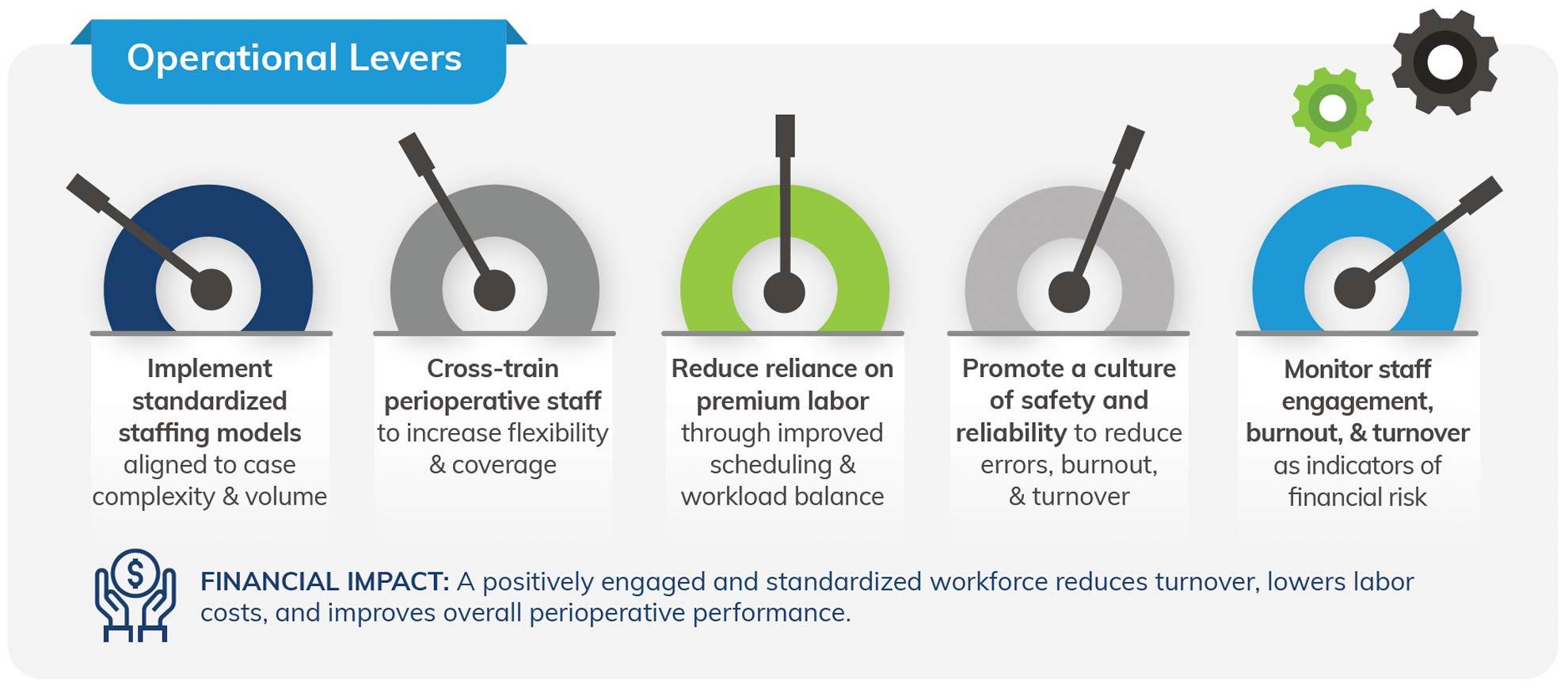
Standardizing staffing models based on case complexity and volume, combined with cross-training perioperative staff, reduces variability and improves flexibility in coverage. These approaches help minimize dependence on travelers and other premium labor by enabling more effective scheduling and workload balance.
Equally important is fostering a positively engaged workforce. High engagement not only enhances patient care but also reduces costly turnover, recruitment expenses, and reliance on locum resources. Monitoring burnout and turnover as leading indicators of financial and operational risk is critical to sustaining performance.
Financial Impact: A positively engaged and standardized workforce reduces turnover, lowers labor costs, and improves overall perioperative performance.
Operational Levers
- Implement standardized staffing models aligned to case complexity and volume.
- Cross-train perioperative staff to increase flexibility and coverage.
- Reduce reliance on premium labor through improved scheduling and workload balance.
- Monitor staff engagement, burnout, and turnover as indicators of financial risk.
- Promote a culture of safety and reliability to reduce errors, burnout, and turnover.
5,6
6. Optimize Supply and Instrumentation Management to Eliminate Bottlenecks
Identifying Hidden Constraints
Many perioperative inefficiencies are driven not by operating room capacity, but by variability and breakdowns in supply chain and instrumentation management. Delays in instrument availability, incomplete or inaccurate preference cards, sterilization backlogs, and limited visibility into supply status frequently disrupt case flow and contribute to day-of-surgery delays and cancellations.
While factors such as preoperative assessment variability, PACU constraints, and bed availability remain important, supply and instrumentation challenges are often the most immediate and controllable barriers to consistent throughput. When instruments, implants, or required supplies are not available at the right time, even well-optimized OR schedules cannot be executed reliably.
Improvement Strategies
- Standardize and continuously maintain surgeon preference cards to ensure accuracy of instruments, implants, and supplies required for each case.
- Implement real-time tracking and visibility of instrument trays, case carts, and critical supplies across sterile processing and the OR.
- Align sterile processing capacity, staffing, and case cart assembly with daily and forecasted OR demand to prevent bottlenecks.
- Establish par levels and inventory management protocols for high-volume and high-risk supplies to reduce last-minute shortages.
- Create defined escalation pathways for missing instruments, implants, or vendor-related delays to minimize room idle time.
- Integrate sterile processing schedules directly with OR block schedules and daily case volume forecasts.
- Standardize room setup processes to ensure consistency and reduce variation in supply readiness.
Financial Impact: These improvements directly lower cost per case by reducing unnecessary supply utilization, minimizing rework, and limiting reliance on expedited vendor support, while simultaneously improving overall perioperative margin performance.
7. Case Mix and Service Line Optimization
Health systems are under increasing pressure to ensure that operating room access, surgeon scheduling, and service line strategy are aligned to support both growth and profitability. Improving surgeon access is a critical lever in this effort. Many organizations have expanded block time in response to volume recovery goals, but without a data driven approach, this often leads to underutilized OR time, misaligned resources, and diminished financial performance.
A more effective model uses analytics to align block allocation and scheduling with surgeon performance, demand patterns, and strategic priorities. This ensures that high value cases are prioritized, OR time is fully utilized, and service lines are positioned for sustainable growth. At the same time, the continued migration of lower acuity procedures to ambulatory settings requires hospitals to be more intentional about which cases remain in the inpatient setting and how those cases are supported operationally.
Optimizing case mix, ensuring the right procedures are performed in the appropriate setting, such as shifting lower acuity cases to ASCs while reserving hospital ORs for more complex cases, is critical to improving efficiency and profitability. As a top priority for healthcare executives, service line optimization must be closely aligned with case mix strategy to ensure resources are directed toward the highest value care and sustainable growth opportunities.
Financial Impact: By aligning surgeon access and scheduling with case mix optimization, organizations can maximize resource utilization while supporting stronger financial and operational outcomes. Data driven access rules improve volume while reducing overtime and anesthesia subsidy pressure.
8. Continuous Measurement and Benchmarking
Sustaining Improvement
Operational improvement is not a one-time initiative. Sustained financial performance requires continuous monitoring, benchmarking, and adjustment. Performance transparency reinforces accountability and drives engagement.
Financial Impact: By consistently measuring each area you know when your improvements will positively impact your finances. Conversely, when there are changes that negatively impact your goals you see them before they become financial issues.
COO Action Steps
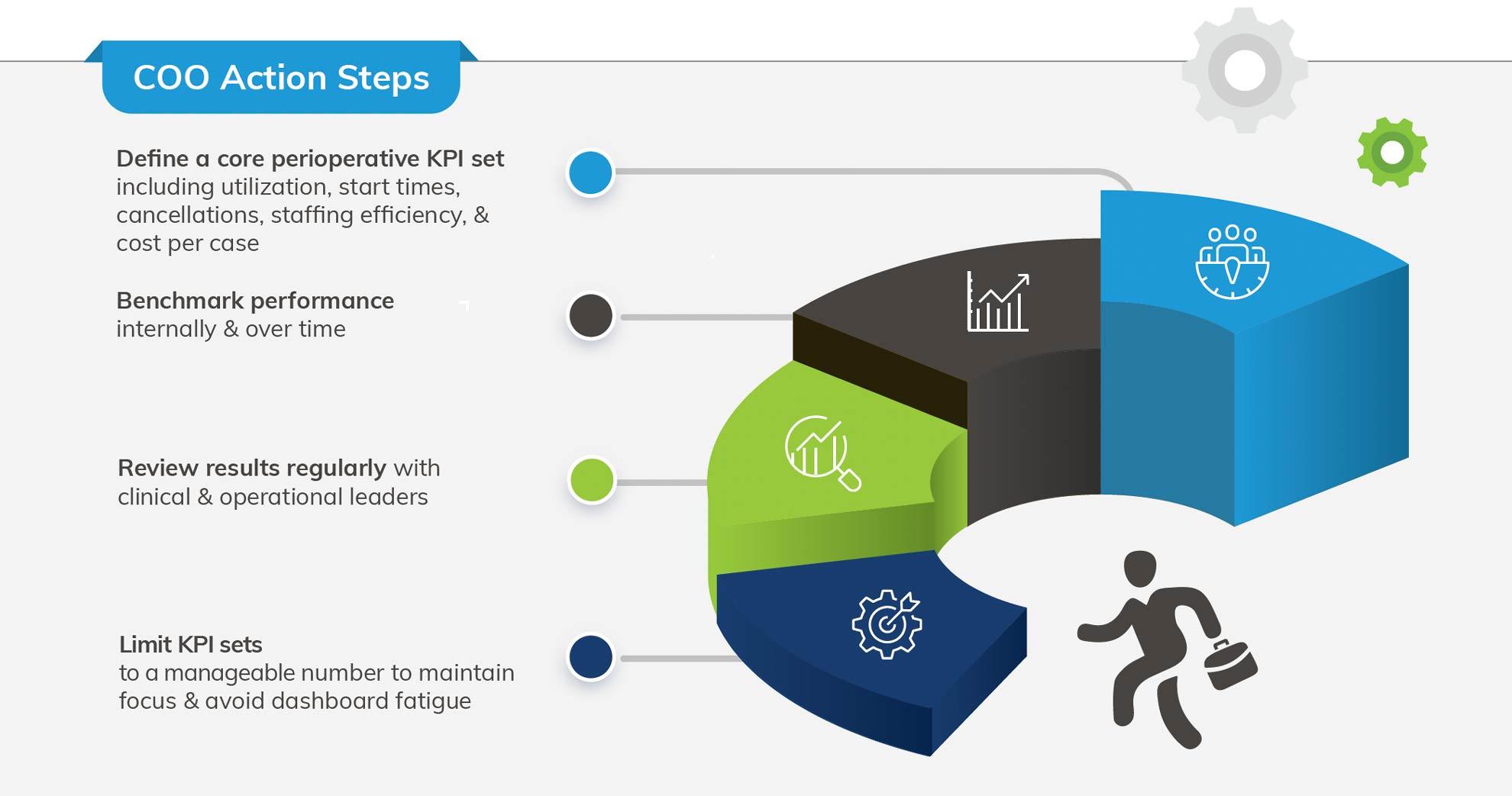
- Define a core perioperative KPI set including utilization, start times, cancellations, staffing efficiency, and cost per case.
- Benchmark performance internally and over time.
- Review results regularly with clinical and operational leaders.
- Limit KPI sets to a manageable number to maintain focus and avoid dashboard fatigue.
Conclusion
For COOs, operational excellence in surgical services is inseparable from financial performance. By establishing strong governance, optimizing scheduling accuracy and utilization, improving start-time reliability, aligning perioperative capacity, standardizing workforce models, and continuously measuring performance, hospitals can unlock significant financial improvement without compromising quality or access.
The most successful organizations treat perioperative services not as a cost center to be managed, but as a strategic asset that strengthens financial performance, workforce stability, and access through disciplined operations and collaborative leadership.
Download this whitepaper in PDF format.
References
- Surgical Directions. “A Hospital CEO’s Guide to OR Financial Improvement.” Chicago, IL: Surgical Directions; 2024.
- Surgical Directions. “Hospitals Improve Utilization 20% and Surgical Volume 25% with Cultural Transformative Tactics.” Press Release; 2024.
- Surgical Directions. “Four Tactics to Transform Culture in Surgical Services.” White Paper; 2024.
- Surgical Directions. “Rapid Innovation with Merlin™: Solving Block Management Issues and Improving OR Efficiency.” White Paper; 2024.
- Association of Perioperative Registered Nurses (AORN). “Perioperative Efficiency Tool Kit.” Denver (CO): AORN; 2016.
- Association of Perioperative Registered Nurses (AORN). “Position Statement on Perioperative Staffing and On-Call Practices.” Denver (CO): AORN; 2021.
- Surgical Directions. “Technology Innovation to Optimize OR Staffing Decisions.” White Paper; 2024.
- Surgical Directions. Merlin™ “Nurse Staffing Module: Revolutionizing OR Staffing with Predictive Analytics.” Press Release; 2024.
- Surgical Directions. Merlin™ “Anesthesia ContractCompare Saves Hospitals Over $2 Million Since Launch.” Press Release; 2024.
- Weiser TG, Haynes AB, Molina G, et al. “Estimate of the global volume of surgery in 2012.” Lancet. 2015;385(Suppl 2):S11.
- Smith CD, Spackman T, Brommer K, et al. “Reengineering the operating room using variability methodology.” J Am Coll Surg. 2013;216(4):559–568.
- Association of Perioperative Registered Nurses (AORN). “Five Ways to Enhance Operating Room Efficiency.” AORN; 2024.
- Harders M, Malangoni MA, Weight S, Sidhu T. “Improving operating room efficiency through process redesign.” Surg Clin North Am. 2015;95(1):17–41.
- Pandit JJ, Abbott T, Pandit M, Kapila A, Abraham R. “Is starting on time a useful surrogate for OR efficiency?” Anaesthesia. 2012;67(8):823–832.