
Executive Insights from the Surgical Directions Expert Panel Series
Introduction: Why Sterile Processing Is Rising to the Executive Agenda
Across hospitals and health systems, operating room performance remains one of the most visible measures of operational success. Case throughput, surgeon satisfaction, and patient safety all hinge on one critical, but historically overlooked, department: Sterile Processing (SPD).
While hospital leaders have long focused on optimizing perioperative services, the underlying infrastructure that enables safe surgery has often received far less strategic attention. Yet without reliable instrument processing, surgical access stalls, costs rise, and patient safety risks increase.
Recognizing this growing challenge, Surgical Directions launched its Expert Panel Series, convening senior healthcare executives and sterile processing leaders from leading pediatric hospitals to discuss the evolving realities of SPD operations. The goal of the series is simple but powerful:
Create a patient-centered forum where hospital leaders can openly discuss operational challenges, exchange effective strategies, and collaborate to improve surgical outcomes, enhance patient experiences, and drive high-quality, efficient care delivery.
This white paper summarizes the insights emerging from the inaugural panel discussion focused on sterile processing in pediatric hospitals. While the participants represented children’s hospitals, the lessons and operational pressures discussed are broadly applicable across health systems nationwide.
The conversation revealed a clear message for healthcare executives: Sterile processing is no longer a back-of-house support function. It is a strategic enabler of surgical access, safety, and financial performance.
The Growing Complexity of Sterile Processing
Healthcare organizations are operating in an environment where surgical services are both mission critical and financially essential. At the same time, the complexity of surgical instrumentation continues to increase.
In pediatric settings especially, surgical teams rely on:
- Highly specialized instruments
- Increasing regulatory scrutiny
- Rigorous infection prevention practices tailored to vulnerable populations
- Precise instrument tracking and identification systems
- Highly trained staff with pediatric-specific competencies
- Meticulous inspection, testing, and quality assurance processes
- Strong communication and coordination between Surgery and SPD
- Efficient case turnover without compromising safety or quality
- Availability of limited and highly specialized instrument inventories
- Standardization of trays and processes across pediatric specialties
- Adaptability to new technologies and evolving surgical techniques
Surgical services, whether pediatric or adult, rely on complex instrumentation with detailed IFUs that must be consistently followed. The challenge is not defined by patient population, but by the precision, variability, and coordination required to reliably execute these processes across a diverse and often highly specialized instrument inventory. As panel participants discussed, this complexity dramatically raises the operational stakes for sterile processing teams.
When SPD functions well, surgery flows seamlessly. When it does not, the impact is immediate. Common consequences include:
- Delayed surgical cases
- Surgeon frustration
- Staff tension between OR and SPD teams
- Increased infection risk
- Financial losses from reprocessing and inefficiencies
The panel highlighted that many hospitals historically underestimated the operational sophistication required to run a high-performing sterile processing department. That perspective is changing rapidly.
The Relationship Between the OR and SPD: A Critical Partnership
One of the most consistent themes in the discussion was the importance of alignment between the operating room and sterile processing teams. In many hospitals, these departments have traditionally operated as separate entities with limited integration. When issues arise—such as missing instruments or tray defects—the natural tendency is to assign blame rather than diagnose the root cause.
Panelists emphasized that the most successful organizations are shifting toward a shared team model, where sterile processing is viewed as an equal partner in surgical care delivery. This cultural shift often requires leadership intervention. Hospitals that have improved performance described several common strategies:
- Creating joint leadership structures across the OR and SPD
- Integrating sterile processing into perioperative governance
- Establishing shared operational meetings
- Encouraging real-time communication between teams
Executives noted that when sterile processing is organizationally aligned with surgical services, collaboration improves significantly. Instead of two separate teams working in isolation, the organization begins operating as one surgical ecosystem.
Communication Structures That Drive Operational Alignment
The panel revealed that hospitals achieving stronger OR–SPD relationships typically implement formal structures that support continuous communication. Common mechanisms include:
Daily Huddles
Brief daily discussions help identify equipment needs, procedural complexities, and operational risks before the surgical day begins.
Cross-department leadership touchpoints
Regular check-ins between OR leaders and SPD managers help surface issues early and ensure accountability for resolving them.
Service-line partnerships
Some hospitals assign sterile processing staff to specific surgical specialties, allowing them to develop deeper familiarity with specialized equipment.
Real-time problem resolution
Rather than escalating issues through multiple layers of management, some organizations empower designated liaisons who can quickly investigate tray issues during surgical cases.
These operational structures help shift the dynamic from reactive troubleshooting to proactive collaboration.
Culture and Accountability: The Hidden Drivers of Performance
Another major theme emerging from the panel was the role of organizational culture in sterile processing performance.
Several participants described environments where long-standing tensions existed between nursing teams and sterile processing staff. In some cases, SPD personnel experienced frequent criticism without a clear understanding of the root causes of operational problems.
Leadership intervention proved essential in addressing these challenges.
Successful hospitals focused on:
- Establishing clear behavioral expectations across teams
- Addressing disruptive behavior quickly
- Ensuring accountability at all levels of the organization
- Reinforcing the shared goal of patient safety
Organizations that actively addressed culture reported significant improvements in staff engagement and operational reliability. When leaders reinforce mutual respect between departments, collaboration increases and problem-solving becomes more effective.
Why Sterile Processing Remains Underinvested
Despite its critical role, sterile processing has historically been one of the most underfunded departments in the hospital. Participants noted that sterile processing is often viewed as a cost center rather than a value generator, which can limit investment in staffing, technology, and infrastructure. However, panel discussions revealed that this perspective overlooks the significant financial implications of sterile processing performance. For example, when instrument sets must be reprocessed due to contamination or defects, the cost is far from negligible.
Each reprocessing event may include:
- Labor across multiple processing stages
- Sterile processing equipment utilization
- Packaging materials
- Chemical and energy usage
Industry estimates discussed during the panel suggest that reprocessing a single tray can cost approximately $80 or more, depending on the organization’s cost structure. Additionally, per Surgical Directions’ CEO, Leslie Basham’s experience, financial implications can be significant. Although rare, SPD can shut down an OR when serious issues occur. In a 15 OR hospital if you were to lose 5 cases a day at $10,000 contribution margin (CM) per case you are losing $750,000 a day. (5 cases a day x $10,000 CM x 15 ORs = $750,000 per day)”
Beyond direct costs, the financial impact expands significantly when case delays occur. Consequences may include:
- Lost OR time
- Staff overtime
- Surgeon dissatisfaction
- Reduced surgical throughput
In other words, underinvestment in sterile processing can ultimately create far greater downstream financial consequences.
The Metrics Problem: A Major Gap in Healthcare Operations
One of the most surprising findings from the discussion was the lack of standardized key performance indicators for sterile processing. While many hospital departments rely on widely accepted benchmarks, the SPD lacks consistent national standards for measuring performance. Participants described several challenges related to measurement:
Inconsistent staffing benchmarks
Some hospitals rely on broad healthcare benchmarks such as average daily census, which have little correlation to sterile processing workload.
Limited external benchmarks
There are few industry benchmarks available for:
- tray processing volume
- defect rates
- staffing ratios
- productivity levels
Difficulty measuring true workload
Sterile processing demand is not driven solely by surgical case volume. It is influenced by factors such as:
- instrument complexity
- number of trays per case
- clinic instrument processing
- priority tray volume
- non-SPD work such as code carts & floor equipment cleaning & distribution
Without standardized metrics, many SPD leaders struggle to justify staffing and resource needs to hospital leadership. Panel participants expressed strong interest in developing shared industry benchmarks that could support more informed operational decision-making.
The Future of Sterile Processing: Data, Integration, and Strategic Investment
As surgical services continue to evolve, sterile processing will increasingly require advanced operational management and strategic oversight.
Hospitals that are successfully improving performance are focusing on several priorities:
Data transparency
Tracking instrument defects, reprocessing events, and operational interruptions provides critical insight into workflow challenges.
Operational integration
Bringing sterile processing into perioperative leadership structures improves coordination and accountability.
Workforce development
Training and professionalizing SPD teams helps improve quality and staff retention.
Technology adoption
Instrument tracking, monitoring AI systems and digital workflow tools are beginning to transform sterile processing visibility and efficiency.
Executive engagement
Perhaps most importantly, hospital leadership is becoming more aware of the strategic importance of sterile processing.
The conversation highlighted a growing consensus: High-performing surgical programs require high-performing sterile processing departments.
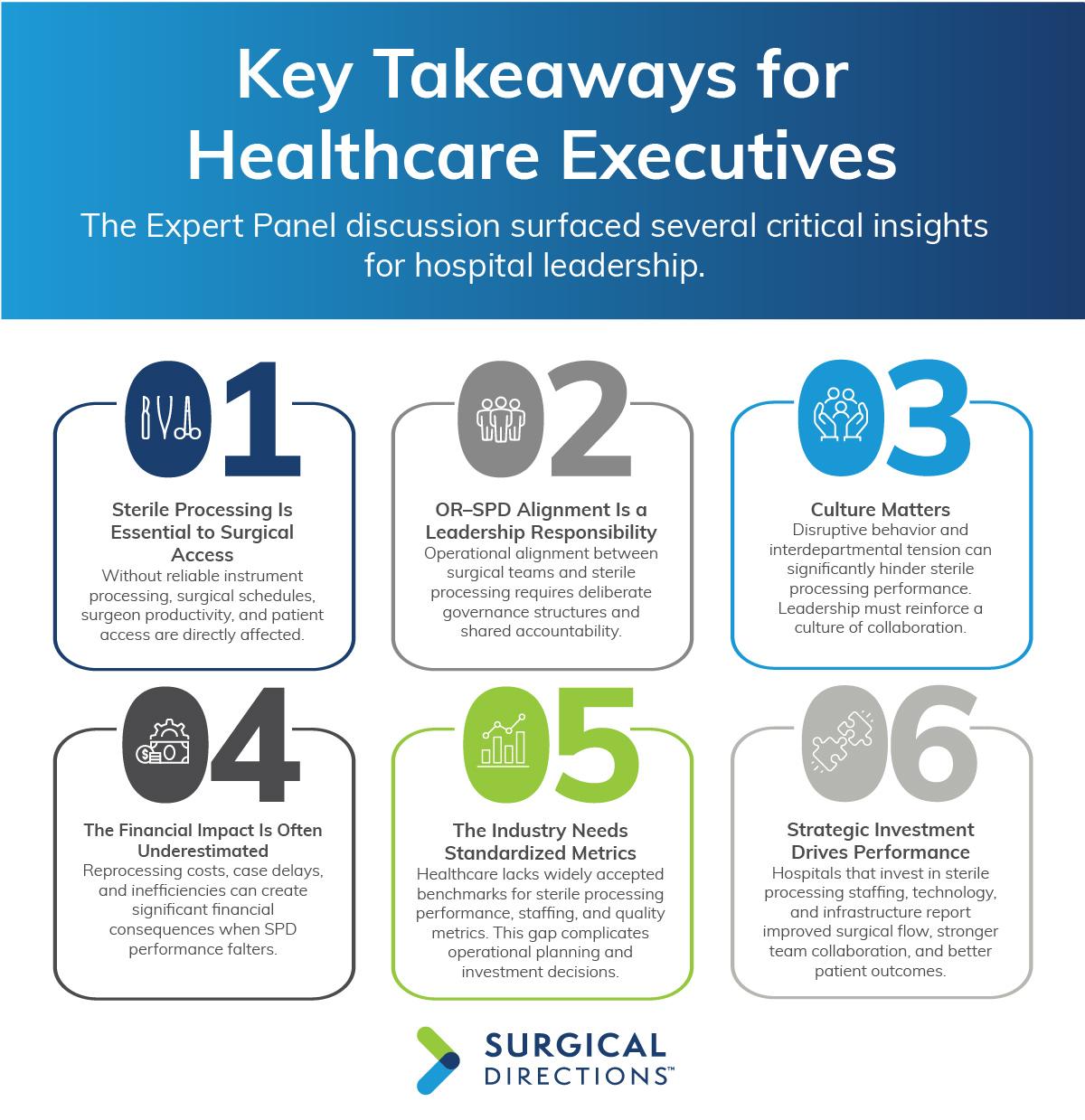
Key Takeaways for Healthcare Executives
The Expert Panel discussion surfaced several critical insights for hospital leadership.
- Sterile Processing Is Essential to Surgical Access: Without reliable instrument processing, surgical schedules, surgeon productivity, and patient access are directly affected.
- OR-SPD Alignment Is a Leadership Responsibility: Operational alignment between surgical teams and sterile processing requires deliberate governance structures and shared accountability.
- Culture Matters: Disruptive behavior and interdepartmental tension can significantly hinder sterile processing performance. Leadership must reinforce a culture of collaboration.
- The Financial Impact Is Often Underestimated: Reprocessing costs, case delays, and inefficiencies can create significant financial consequences when SPD performance falters.
- The Industry Needs Standardized Metrics: Healthcare lacks widely accepted benchmarks for sterile processing performance, staffing, and quality metrics. This gap complicates operational planning and investment decisions.
- Strategic Investment Drives Performance: Hospitals that invest in sterile processing staffing, technology, and infrastructure report improved surgical flow, stronger team collaboration, and better patient outcomes.
Continuing the Conversation
The Surgical Directions Expert Panel Series was created to bring together healthcare leaders to address the operational realities shaping modern surgical services. The inaugural discussion confirmed that sterile processing is emerging as one of the most important—and least understood—drivers of surgical performance.
Future panel sessions will continue exploring critical topics such as:
- AI Utilization in Hospital Operations
- Supply Chain Optimization
- Improving Perioperative Throughput
- Anesthesiology Challenges within Surgical Services & NORA
By fostering peer collaboration among hospital leaders, the Expert Panel Series aims to accelerate the adoption of best practices across healthcare systems.
Because ultimately, the success of surgical services depends not only on what happens in the operating room—but also on the complex systems that support it. Would you like to join one of our Expert Panel Cohorts? If so, please complete our contact form.